“The movement of this vast flow of money was, however,
increasingly mysterious. As the American financial strategist David
Smick put it succinctly, ‘the industrialised world…surrendered
control of its financial system to a tiny group of 5,000 or so technical
market specialists spread throughout investment banks, hedge funds,
and other financial institutions.’ The problem, of course, was
not simply that governments and regulators hadn’t a clue what
these 5,000 wizards were up to, but that the wizards themselves made
the Sorcerer’s Apprentice look like Gandalf. Driven by greed
and short-term incentives, and locked in a small world where money
was increasingly distanced from its sources in the real economy, they
were oblivious to the inevitability of the catastrophe they were creating.”
David Smick, a well-known
international financial adviser who is well acquainted with the heads
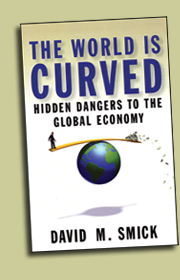
of central banks around the world, recently published a book entitled The
World Is Curved: Hidden Dangers to the Global Economy.
Smick says in the book that in the world of financial markets, the
world is not flat, but curved.
He says we cannot see the dangers beyond the horizon because of the
lack of financial market transparency, therefore we cannot always identify
risks.
Smick writes that China’s
attempt to combine a market economy with a Marxist regime is asking
too much, and that while China is capable of bringing the world into
a new era of prosperity, it could also drag us all into chaos.”
These people, Smick
said, have, however, underestimated the US economy’s ability to import
capital. ‘They have ignored the US economy’s
dynamism and its role as an international safe haven. These sceptics
only focused on the size of the current account deficit,’ he said.
From “Today’s
Papers,” Slate, by Daniel Politi, March
10, 2009:
“‘In
the WP’s op-ed page, David Smick writes
that since there are no solutions to the banking crisis that don’t
involve huge political and financial risks, Obama’s economic
advisers ‘have
adopted a three-pronged approach, delay, delay, delay.’ While
many have been advocating for nationalization, there’s a simple
reason that officials are terrified to go down the road. Yes, it’s
the good old credit-default swaps again. ‘These paper derivatives
have become our financial system’s new master,’ declares
Smick. The truth is no one knows what will happen, and it seems the
Obama administration is paralyzed by fear. It’s time for Obama
to come clean to the American people, recognize the magnitude of the
problem, and appoint a well-known figure who is not from Wall Street
to deal with the mess. ‘The
longer we delay fixing the banks, the faster the economy deleverages,
the more credit dries up, the further the stock market falls, the higher
the ultimate bank bailout price tag for the American taxpayer, and
the more we risk falling into a financial black hole from which escape
could take decades.’” [Read
David Smick’s March 10 op-ed in the Washington Post.]
From “GOP at the Abyss” by
columnist Michael Gerson in the Washington Post, March 6, 2009:
“‘It’s not smart to say this economy can’t recover,’ says
economist and author David Smick. If
the pipeline of credit is somehow unclogged, the Federal Reserve has
provided plenty of money for there to be a quick recovery. Americans
will eventually need to buy houses or cars again.”
From “Why Mitt Romney Gets It” by
James Pethokoukis, U.S. News and World Report, February 27, 2009:
“Analysts keep forgetting how the halving of the
stock market has crushed people’s net worth and is contributing
to a reverse wealth effect. And what if people fall permanently out
of love with the idea of building wealth by building assets through
stocks? It will be a huge drag on the economy moving forward since
people will be saving too much in low-yielding assets and not taking
full advantage of global economic growth when it returns. This is a
point economic consultant David Smick makes
in his great book, The World Is Curved. (A
book, by the way, Romney just finished reading.)”
From “The
Deeper Roots of Our Financial Crisis,” by
Theodore Roosevelt Malloch in The American Spectator, February 11,
2009:
“Certainly macroeconomic weakness, heightened economic
imbalances, over-leverage and extreme credit risks have contributed
to the unbelievable levels of market volatility we have witnessed in
this downturn, now become a near collapse. Almost all financial experts
and many policymakers have started to cry out for financial reforms,
greater financial transparency and measures to rebuild confidence.
Trust is needed in the financial architecture and institutions, regulatory
agencies among them, that underlie our now highly interconnected global
economic system. Yet this is why the sage market advisor, David
Smick spells out so explicitly in his book, The
World Is Curved, ‘The
distasteful reality is that there are no quick fixes for the global
credit system’s dilemma, which is why the world has become a dangerous
place with so much economic heartache.’”
From “It’s
Not the Bonus Money. It’s the Principle,” by Joe Nocera
in the New York Times, January 31, 2009:
“But there is something else as well. Most people
still don’t fully understand what, exactly, Wall Street did that
caused so much trouble for the country and the financial system. I
spoke this week to David M. Smick, author
of a scathing book about Wall Street, The World
Is Curved: Hidden Dangers to the Global Economy. In indignant
tones, he talked to me about the sophisticated off-balance-sheet vehicles
the banks used to hide risk and game the system, and the ‘mortgage-backed
securities they were shoving out the door.’ He concluded, ‘I
find their behavior just appalling.’
But words like ‘off-balance-sheet vehicles’ and ‘mortgage-backed
securities’ don’t have much meaning for most of us. What
we understand is greed—which, ultimately, is what Mr. Smick was
talking about as well. For most Americans, big bonuses and corporate
jets and office remodelings become a kind of stand-in for the real
sins of the bankers. They signify what people hate about Wall Street.”
From “Global
Crisis versus Leaders’ Priority,” by Yemi Kolapo in Punch (Nigeria),
January 29, 2009:
“David Smick, in his book on the current
global financial crisis titled, The World Is Curved, argued
that under normal conditions, the global financial system could have
absorbed the housing bubble burst where the initial subprime exposure
was a mere $200bn in a global economy worth several hundred trillion
dollars, but for a greater nuisance—a dubious dual system set
up by banks to hide their exposure to market risk. Smick described
the crisis as a ‘tale of greed, hypocrisy and sheer folly that
the bankers don’t want you to know, brought about by the mother
of all regulatory failures in realising what was happening.’ Watchers
of the Nigerian banking sector affairs can draw a similarity here.”
From “Time
for (Self) Shock Therapy,” by
columnist Thomas Friedman in the New York Times , January
18, 2009:
“‘Right now,’ said David
Smick, author of The
World Is Curved, ‘the bankers are sitting on mountains
of cash, including our bailout money, because they know their true
balance sheets are a disaster—far worse than publicly stated.’ The
situation will likely worsen as delinquent consumer and auto loans
are piled atop bad mortgages. ‘Obama needs to inject some truth
serum into the banking discussion. No one trusts the banks, and even
the banker’s dont trust each other.’ Bringing clarity to
bank balance sheets, said Smick, ‘is the first step to fixing
America’s bank lending problem.’”
From “Obama’s
First Job Is Buying Brain-Dead Banks,” by Michael Sesit for Bloomberg,
January 20, 2009:
“[R]equire banks to invest some of their TARP funds
in Fannie Mae and Freddie Mac bonds. That would help lower mortgage
rates and boost refinancing. Banks would have no excuse for refusing
to buy the mortgage-lenders’ debt, since it is explicitly government
guaranteed, David Smick, head of consulting
firm Johnson Smick International Inc. in Washington, said.”
From “Memo
to the Banks: Lend or Else,”
by David Smick in the Washington Post, January 12, 2009:
“Obama needs a big play. The place to begin is by confronting
our banking system—possibly even breaking up the financial behemoths
considered ‘too big to fail.’ Our banks are sitting on mountains
of capital. Taken together, their excess cash reserves normally amount
to $3 billion to $7 billion. Astonishingly, those reserves today are
estimated to exceed $800 billion, a portion of which is our bailout
money. We have moved from reckless financial risk-taking to a situation
even more dangerous: no financial risk-taking. Many suspect that this
cash buildup indicates that the banks’ off-balance-sheet debt
exposure is far larger than acknowledged.”
From “Mr.
Cool’s Centrist Gamble,” by Washington
Post columnist
David Ignatius, January 11,
2009:
“Obama’s bet is that at a time of national economic crisis, the country
truly wants unity. ‘I keep telling Republicans, ‘This guy has to succeed.’ Otherwise, we’re doomed,’ says David Smick, a financial analyst who wrote a prophetic book about the economic
crisis called The World Is Curved. But
it remains an open question whether the Republicans will do more than applaud
politely when Obama asks for help.”
From “Why
Regulators Always Lose,” by Rich Lowry in the Austin-American
Stateman, January 10, 2009:
“As David Smick writes in The
World Is Curved: ‘A well-intentioned government bureaucrat
is no match for the kind of creative and clever market wizards, and their lawyers,
who begin searching for legal means around any regulatory constraint the instant
the regulations are put in place. Today a senior Securities and Exchange Commission
(SEC) officer earns between $143,000 and $216,000 per year. Even junior executive
decision-makers at Goldman Sachs garner annual compensation packages in the millions
of dollars.’”
From “Good
Luck, Barack,” by David Smick in Foreign Policy, January/February
2009:
“The one silver lining is that the world does not lack capital. It’s
simply sitting on the sidelines, including $6 trillion in global money market
funds alone. The faster Obama and his global counterparts can fashion credible
financial reforms that enhance transparency while preserving capital and trade
flows, the sooner that sidelined capital will reengage. In the end, markets crave
certainty—in this case, certainty that our leaders have a credible game
plan. That plan is not yet in place.”
From “Don’t Pull Back:
‘Progressive’ policies would cause economic regression,” by
Pete du Pont in the Wall Street Journal, December 16, 2008:
“Economist David M. Smick’s
recent book, The World Is Curved, shows
that during the past quarter-century we have had a global ‘golden age of wealth creation and poverty reduction
never before seen in the history of mankind.’ The global free
market ‘experienced an unprecedented doubling of its labor force
from 2.7 billion to 6 billion’; the U.S. had 40 million new jobs
created; ‘the Dow Jones Industrial Average climbed from 800 to
over 12,000’ (it is back under 9000 now); and, according to the
Federal Reserve, U.S. households saw their net worth increase from
$11 trillion in 1982 to more than $56 trillion today.”
He says markets aren’t responding to billions
in global stimulus simply because of the sheer magnitude of what
could still go wrong.
The problem, he writes, is that we’re still at risk from (count ’em)
eight financial bubbles of varying sizes. His rough breakdown looks
like this:
A number of analysts talk about eight bubbles ranging from the subprime
mortgage loans (again, $1.5 trillion) to emerging market debt ($5 trillion)
to outstanding credit card debt ($2.5 trillion) to commodities derivatives
($9 trillion) to commercial real estate ($25 trillion) to foreign exchange
derivatives ($56 trillion) to credit default swaps ($58 trillion) and
so on.
In a worst-case scenario, he says those bubbles could mean roughly
$200 trillion worth of financial exposure.”
From “A
Bailout Stuck in Low Gear," by David Ignatius in the Washington
Post, November 22, 2008: “David
Smick, whose
book The World Is Curved provided
an eerily accurate forecast of the economic disaster we’re now
experiencing, was reviewing some numbers last week that help clarify
the crisis. He noted that banks’ excess cash reserves, which
normally total less than $7 billion, have recently approached $400
billion. A lot of that is taxpayer money that the banks aren’t
putting to use.
Why? ‘You’d have to be crazy to lend in this
environment,’ says Smick. ‘They aren’t lending because
it’s going to be a terrible 2009’ and the banks don’t
want to get caught.”
From “Books
I’m Thankful for This Year,” by
Gloria McDonough-Taub for CNBC.com, November 21, 2008: “The
World Is Curved: Hidden Dangers to the Global Economy by David
Smick. Thank you thank you thank you, because
I really, really didn’t believe the world was flat and this truly
was an important book that came at the right time. My biggest hope
is that we will indeed find the right combination of global leaders
who are bold enough and smart enough to lead us out of this unimaginable
financial mess.”
From “End of the Reagan-Clinton Era?” by
Rich Lowry in the National Review, November 4, 2008:
“In terms of our globalized economy, we’ve
been living in the Reagan-Clinton years. As David
Smick writes in his compelling
new book on the financial system, The World
Is Curved: ‘Globalization
was not a Republican or Democratic phenomenon. Indeed, there was not
much difference in economic policymaking between Democrat Bill Clinton
and Republican Ronald Reagan.’”
From “Two Books to Understand the Economy,” by
Michael Barone for U.S. News and World Report, October 29, 2008:
“If you want to understand the economic events
of the last half century, you should read two new books. One is Robert
Samuelson’s
The Great Inflation and Its Aftermath: The Past and Future of American
Affluence, which explains how the abstract economic theories of Keynesian
economists produced not the promised eternal economic growth but the
longest sustained peacetime inflation in American history, rising to
14 percent in the times of Jimmy Carter. The other is David
Smick’s The World Is Curved: Hidden Dangers to the Global Economy, which
explains how the abstract mathematical models of financial wizards
produced not the promised eternal self-sustaining economic growth but
rather a nontransparent financial system, which led to the coagulation
of credit and our current financial crisis. Both show how abstract
theories proved faulty in practice; both recommend similar common-sense
responses: intelligently regulated transparent markets.”
From “If
Entire Countries Go Broke, We’ll
Go With Them,” by David Smick in the Washington
Post, October
26, 2008:
“The global financial market is like a rich, generous but occasionally
paranoid great uncle. Normally, this benevolent great uncle sprinkles
money calmly and wisely throughout the family, taking a careful reading
of risk and potential investment reward. But every so often, a deep
paranoia overtakes him. Panicked, he turns off the spigot. Why? Sometimes
he thinks his relatives are not telling him everything he needs to
know. Other times, paranoia sets in because the facts of a relative’s
scenario don’t add up.
Today the great uncle has reached a level of paranoia
not seen since the 1930s, and the massive ‘shock and awe’ campaign
of bold rescue efforts from the world’s wealthiest countries
has not calmed him down. The world financial market still thinks
the numbers don’t add up.
This is primarily because of a new
and fast-moving blip on the global radar screen: the growing concern
that entire countries could default on their financial obligations.
While Washington frets about bank failures and the potential collapse
of the corporate sector, the financial market is far ahead of it.
Global markets are now fixated on the economic, social, political
and foreign policy shipwrecks that could be triggered if waves of
country defaults sweep across the world.
In an alarming number of
nations, the amount of dubious debt held by the domestic banking
system dwarfs the country’s GDP. This is particularly true
in such emerging capitalist economies as Hungary, Iceland, Belarus,
Ukraine and Pakistan.
That’s scary. In the past, some emerging market
economies have defaulted (Argentina comes to mind) and managed to
survive without dragging the rest of the world off a cliff. But things
are different today. The global financial system itself is on life
support. If an emerging market collapses, the damage won’t be
limited to just one country.
Here’s why all this matters to the average working American:
Emerging markets are major purchasers of U.S. exports and a critical
engine of global growth. If their economies fail, ours will fail, too.
The
root of today’s credit crisis is not that the world lacks money;
the world is awash in cash, with $6 trillion sitting idly in global
money markets alone. But if countries start to fail, the remainder
of the world’s investment capital could be spooked out of productive
investments as well.
Nor do we have the tools to avert disaster. The
International Monetary Fund’s resources are a pittance compared
to the financial exposure of the countries in most danger. And as a
result of the industrialized world’s government bailouts and
bank guarantees, there won’t be any more capital for emerging
markets that are still flailing.
Take, for example, a country as large
and powerful as Germany: Deutsche Bank’s assets represent 80
percent of the nation’s GDP. In Switzerland, the assets of the
bank UBS represent 450 percent of the country’s GDP. The financial
exposure of the British banks is similarly alarming: Barclays PLC’s
assets amount to more than 100 percent of the United Kingdom’s
GDP, and the Royal Bank of Scotland’s
holdings reach 140 percent of British GDP.
These countries aren’t even
the biggest worry. That honor goes to the nations of Eastern Europe
and some of the undercapitalized Asian countries. But globalization
means we’re all connected. If Hungary were to default on its
financial obligations, Austria’s banks would soon collapse. If
that happened, Germany’s banks might well follow suit.
There’s
plenty to fret about in Asia, too. Pakistan is facing default. Many
investors worry about South Korea as well: Its exports are plummeting,
and foreign investors are fleeing an already weak stock market. In
an emergency, would the South Korean government, or even the IMF, have
the resources to come to the rescue? We can’t be sure.
American
investors wouldn’t be of much use, either.
After all, what banker in today’s partially taxpayer-owned, soon-to-be-politicized
financial system would want to testify before Congress about a risky
loan to some small foreign country when safe domestic investments had
been available?
Note, too, that the slowdown in securitization—the
slicing and dicing of assets to be sold as securities—will add
to this potential mess. In the past, the much-maligned process funneled
huge amounts of capital to the developing world. That’s not going
to be happening anymore, at least not for a while.
No wonder global
markets are so jittery about the prospect of countries defaulting.
The rich, developed countries enjoy huge resources that can save them
from financial collapse. But those resources are not unlimited. In
Europe, taxes as a percentage of GDP have grown to 43 percent (compared
to roughly 20 percent for the United States). Translation: If Hungary,
Pakistan or South Korea went broke and European governments were forced
to raise taxes to finance a bailout, the economic pain would be excruciating.
That is why the ‘shock and awe’ of
the current bank bailout efforts hasn’t yet stabilized world
financial markets. Investors suspect that the problem is just too expensive
to confront. The IMF estimates that global banks have already lost
$1.4 trillion. By the time the world fully enters into recession
next year, global bank losses will almost certainly have increased
dramatically. Some experts expect them to reach a whopping $5 trillion.
So
the question remains: Do the world’s governments have the resources
to take on such a massive rescue operation? The global markets aren’t
sure.
Our next president, beginning the day after the election, needs
to call for global contingency plans in case countries collapse—because
the financial market will bet against the global economy as long as
this uncertainty exists. Eliminate that uncertainty, or at least show
how the world economy will cope with such calamities, and our policymakers
can return to the thorny job of cajoling our bankers into lending again.
The great uncle is not assuming that the worst is over.”
From “If
Larry and Sergei Asked for a Loan…” by
Thomas Friedman in the New York Times, October 26, 2008:
“‘Government
bailouts and guarantees, while at times needed, always come with unintended
consequences,’ notes the
financial strategist David Smick. ‘The winners: the strong, the
big, the established, the domestic and the safe—the folks who,
relatively speaking, don’t need the money. The losers: the new,
the small, the foreign and the risky—emerging markets, entrepreneurs
and small businesses not politically connected. After all, what banker
in a Capitol Hill hearing now would want to defend a loan to an emerging
market? Yet emerging economies are the big markets for American exports.’”
From “A curved-earther scans the horizon,” by
Christopher Cook in the Financial Times, October 26, 2008: “Smick also fears that this new world means policymakers at central banks
and in finance ministries have lost some of their tools and their sources
of information. With poorly informed policymakers beholden to unpredictable
and unreliable regimes, he worries that popular pressure will mount to
end financial globalisation, or just tax and regulate it until it flees
offshore. In the book’s view, the US must look to remain an attractive
location for investment, but also correct these imbalances.”
From “Financial muscle moves to Washington,” by
William Neikirk in the Chicago Tribune, October 14, 2008:
“‘The general European view is that the credit crisis will lead to the
permanent neutering of the once-dominant financial-services industry,’ said David Smick, a
global financial expert and author of a book on the global economy. ‘America’s ability to finance risk will be restricted,’ said
Smick, who sounded out European opinion about America’s standing
at the World Bank and International Monetary Fund meetings.”
It is a must-read in Washington, London, on Wall Street
and yes, on Main Street since it clearly and vividly tells us how we
all got into this mess, outlines what needs to be done to get out of
this mess and of equal importance how to thrive while in the midst
of this mess.”
From “The Post-Binge World,” by
Thomas Friedman in the New York Times, October 12, 2008:
“So what could ease this crisis? ‘There is
going to have to be a workout,’ said the financial strategist David Smick, author of The
World Is Curved, a book about
the hidden dangers in today’s global economy. ‘There will
have to be a restructuring of all these institutions to clean up their
balance sheets and recapitalize them.’ Banks and insurance companies
will have to be reconstituted, merged or left to die, until these toxic
assets are properly priced and off the books.
The government’s job—which it is still trying to figure
out exactly how to do—will be to provide a safety net of guarantees
for the surviving banks, so they will be honest about pricing their
assets, and then, once they have been, to help recapitalize them. ‘Government’s
other job,’ added Smick, ‘is to quickly establish the new
rules of the road for truth-in-lending on a global basis. We still
need these kind of lending facilities if the economy is going to grow
again.’”
Begin with the U.S. Treasury’s $700 billion bailout package. This
was presented as some magic pill which, if gulped down, would quickly
restore financial stability.
The ‘shock and awe’ of the sheer size of the taxpayer-funded
bailout would somehow restore confidence. Instead, stock markets collapsed
and credit markets remained frozen.
This is because the credit crisis reflects something more fundamental
than a serious problem of mortgage defaults. Global investors, now on
the sidelines, have declared a buyers’ strike against the sophisticated
paper assets of securitization that financial institutions use to measure
and offload risk.
In recent years, our banks, borrowing to maximize the leverage of their
assets at unheard-of levels, produced mountains of financial paper instruments
(called asset-backed securities) with little means of measuring their
value. Incredibly, these paper instruments were insured by more dubious
paper instruments.
Therefore, the housing crisis was a mere trigger for a collapse of trust
in paper, followed by a de-leveraging of the entire global financial
system. As a result, we are experiencing the painful downward reappraisal
of the value of virtually every asset in the world.
So what are these paper instruments, these asset-backed or mortgage-backed
securities? I like to use a salad analogy. Before the last decade, bankers
simply lent in the form of syndicated loans. But with the huge expansion
of the global economy in the 1990s, which produced an ocean of new capital,
the bankers came up with an idea called securitization.
Instead of making simple loans and holding them until maturity, a bank
collected all its loans together, then diced and sliced them up into
a big, beautiful tossed salad.
The idea was to sell (for huge fees) individual servings of diversified
financial salad around the world.
The only problem: under an occasional piece of lettuce was a speck of
toxic waste in the form of a defaulting subprime mortgage.
Eat that piece of salad, and you’re dead. The overall salad looked
delicious, but suddenly global investors were no longer ordering salad.
No one knew the location of the toxic waste. This distrust heightened
when global interest rates began to rise.
So what does this salad boycott mean for the future and why have financial
markets collapsed so brutally? The markets are telling us the world will
face a serious credit crunch in 2009 regardless of how much money government
spends to remove the toxic salad from bank balance sheets.
Policymakers have no means of forcing the banks to start lending short
of nationalizing the entire financial system. After all, the U.S. banks
alone so far during the crisis have lost upwards of $2 trillion from
their collective asset base.
Most banks are leveraged by more than 10 to 1. Translation: The U.S.
financial system will have a whopping $15 trillion to $20 trillion less
credit available next year than was around a year and a half before.
The cost of money is rising and the availability shrinking.
True, the banks will still lend—but the fear is they will do it
only to people such as Warren Buffett, who don’t need loans. What
is uncertain is the amount of lending to borrowers engaged in entrepreneurial
risk, the center of business reinvention and job creation.
Apart from the economic pain resulting from shrinking credit markets,
we are about to see an earthquake in the relationship between government
and financial markets. The great uncertainty is whether government has
the power to rescue the financial system in times of crisis. It seems
doubtful.
In the United Kingdom, for example, the collected assets of the major
banks are four times the nation’s gross domestic product (GDP).
A similar situation exists in many Euro zone countries. This means government
cannot bail out the system even if it wanted to. Given such massive exposure,
government guarantees in a time of crisis become meaningless.
Yet because of the interconnected web of global financial relationships,
we are all vulnerable to the threat. The collapse of, say, a major European
bank would hardly leave American workers immune.
Our policy leaders in Washington are thinking domestically when the solution
to the credit crisis will be global. It is not that the world lacks money;
it is that the world’s money is sitting on the sidelines—more
than $6 trillion in idle global money markets alone.
The challenge will be to reform our financial system quickly to draw
that global capital back into more productive uses. The first step should
be efforts to make the market for future asset-backed paper more transparent
and credible.
We need a private/public global bank clearing facility. The bankers don’t
trust each other. The central banks, working with the private institutions
in providing enhanced data, need to begin to refashion the world’s
financial architecture.
And while that is happening, the major governments of the world, including
the Chinese, should begin major fiscal efforts to stimulate their weakening
economies.
From “People Who Live in
Glass Häuser,” by
Daniel Gross, in Newsweek and Slate/The
Big Money, October
10, 2008:
“Der Spiegel noted with disapproval
that ‘the total value of all
outstanding mortgage loans in the United States—$11 trillion
(€7.6 trillion)—is almost as large as the country’s
gross domestic product.’ Surely, the good burghers of Brussels
and shopkeepers of England wouldn’t be so foolish with debt,
would they? But in Europe, ‘they
embraced financial capitalism and leverage more than we did,’ says
David Smick, founder of The
International Economy magazine and author
of The World Is Curved. The assets of tiny Iceland’s big
banks were about 10 times the island nation’s gross domestic product.”
From “Financial
chiefs seek global unity,” by David R. Sands, Washington
Times, October 10, 2008:
“‘They’re going to have to do something collectively, because
there is no way the U.S. government or any other country can do something meaningful
on its own,’ said David Smick, head of the
Washington-based market advisory firm Johnson Smick International and author
of the influential new book on the changing world of finance, The
World Is Curved.
Mr. Smick said the economic problems on Main Street could be directly
affected by how the world’s economic powers coordinate policy and deal with structural
problems with the globe’s financial ‘plumbing.’ The recent
panic that started on Wall Street has produced plunging stock values, shrinking
retirement funds and vanishing markets for small-business and consumer loans.
‘The idea that some of these guys seem to have had that you could see a
major bank failure in another country and not have it hurt the American worker
is out the window,’ said Mr. Smick. ‘We’re all connected now.’”
From
“Financial titles rise and fall with news,” by Patti Thorn, Rocky Mountain News, October 9, 2008: “Smick, editor of The International Economy, posits
that this crisis was a long time coming—and he wrote his book
before the $700 billion bailout. Readers will give him credit for prescience
and hope he can tell us what’s coming next. Er, strike that word credit. It tends to make people awfully twitchy these days.”
From “No safe haven, no
exit for the global economy this week,” by David Ignatius, Washington Post, October 9, 2008: “David Smick, whose fine book The
World Is Curved offered
clairvoyant early warnings of disaster, proposes that private financial
institutions might finance 60 percent of the cost of this clearinghouse,
and central banks the remaining 40 percent. To play and get protection,
private institutions would have to share all data, which means coming
clean about the toxic paper on their books.
What matters is the collective commitment to create
a global backstop—so that there is a foundation for lending
and commerce, all the way down the line. ‘What’s happening is the
reappraisal of the value of every asset in the world,’ says
Smick. ‘The solution has
got to be global.’”
From “The Testing Time,” by
David Brooks, syndicated column in the New York
Times, October 7,
2008:
“In his astonishingly prescient book, The World Is
Curved: Hidden Dangers to the Global Economy,David
M. Smick argues that we
have inherited an impressive global economic system. It, with the U.S.
as the hub, has produced unprecedented levels of global prosperity.
But it has now spun wildly out of control. It can’t be fixed
with the shock and awe of a $700 billion rescue package, Smick says.
The fundamental architecture needs to be reformed.
It will take, he suggests, a global leadership class that can answer
essential questions: How much leverage should be allowed? Can we preserve
the development model in which certain nations pile up giant reserves
and park them in the U.S.?”
From “Money
for Nothing: A bird’s-eye view of Wall Street’s nervous
breakdown,” a review by
Matthew Continetti in The Weekly Standard, October 6, 2008: “The
World Is Curved is a discursive book, ranging from Tokyo
to Martha’s
Vineyard, from European Central banker Jean-Claude Trichet to the
decidedly non-European New York senator Charles Schumer. The attentive
reader will quickly grasp two key themes. The first is that the so-called
information economy is imbued with ignorance. A lack of transparency
rules. ‘[I]n the new global economy,’ [David]
Smick writes, ‘this
crazy ocean of global liquidity has not only increased the number
of unknowns but also re-arranged their relationships and relative
importance.’ What
you don’t know really can hurt you.”
From
The Daily Beast (www.thedailybeast.com), October 5, 2008:
“Especially at this time every thoughtful American
needs to learn as much as possible about the relationship of politics
to economics,” says former President Bill
Clinton. He recommends
The World Is Curved to
help understand the Wall Street bailout.
From “Not
So Flat After All” by
Bret Swanson, Forbes, September 29, 2008:
“[A] well-timed and lucid tour of the global economy. With continuing chaos
on Wall Street—and in Washington—[David]
Smick’s insights
appear supremely prescient. Dozens of recent books, of course, predicted doom,
gloom and even ‘financial
Armageddon.’ But
dozens of books always predict these
things. Smick’s warnings warrant
more attention because he mostly eschews the perennially wrongheaded
tsk-tsk triad of the trade, budget and savings deficits. In its place
he substitutes a more nuanced view of the promises and perils of
globalization.”
From “The Clueless: Why
neither presidential candidate knows what’s about to hit him,” by
Nina Easton, Fortune, September 24: “[David] Smick, a longtime investment advisor,
has also played in politics, so I asked him what advice he would
give a candidate. He begins with this diagnosis: The world capital
markets are like a house of cards because of a lack of investor confidence,
which in turn is caused by a lack of transparency. Sour mortgages
weren't the problem so much as the fact that no one, here or abroad,
knew how much toxic stuff was on their books because it had been
securitized into obscure financial instruments. We’ve all heard the
same diagnosis—and the same calls for new government rules—from
both Democrats and Republicans.
But here’s where Smick departs into bolder territory.
Legislative action in Washington isn't the answer, he argues, and
could well hurt U.S. markets. ‘You can’t do it alone,’ says Smick. ‘It’s
too easy to play the central banks off one another. Financial institutions
are too clever at arbitraging different international regulatory systems.’
Instead, he says, the next President, acting with urgency,
should convene a successor to the 1944 Bretton Woods conference, which
gave birth to a post-World War II international monetary system. In
addition to setting transparency standards, the industrial nations
should look to provide a buffer when political turmoil disrupts capital
flows—whether it’s Russia invading Georgia or the possibility
that slowing growth in China will lead to social chaos there.
Smick concedes it won't be easy: ‘Huge amounts of
global capital are held by nondemocratic regimes that aren’t in a cooperative
mood,’ he
says, and democracies have plenty of ‘weak political leadership.”